


Welcome to PRECAST-CO₂
The PRECAST-CO₂ project is focused on developing innovative alternatives for CO₂ capture and utilization (CCU) to reduce the carbon footprint of non-structural precast concrete elements. By implementing sustainable technologies, we aim to contribute to climate change mitigation and promote a circular economy in the construction industry.
Our multidisciplinary research team, from the University of Córdoba, is working to integrate CO₂ capture into new materials for construction, making the industry more efficient and environmentally friendly.
Join us on this journey toward a more sustainable future!
The Project

SUMMARY
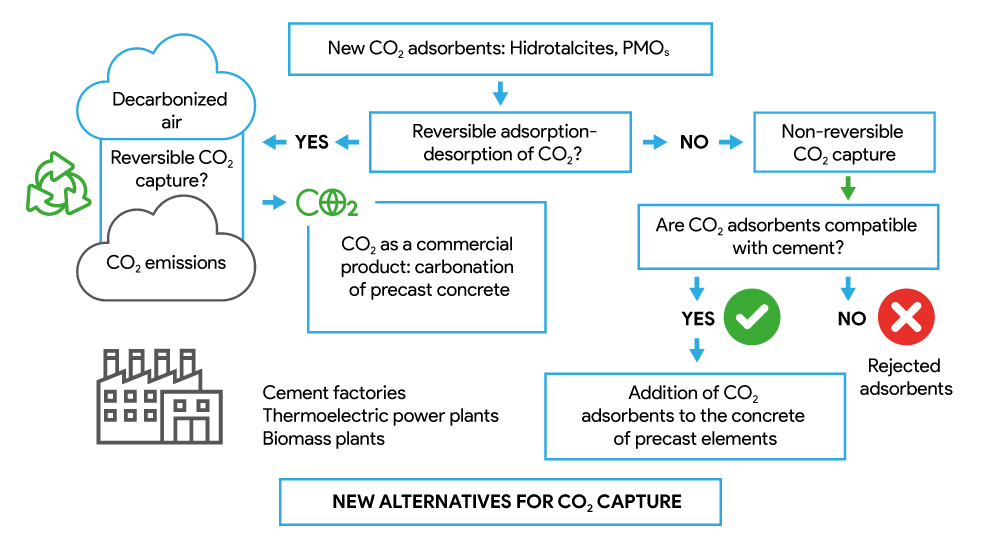
PRECAST-CO₂ explores six complementary approaches to capture and utilize CO₂ in the production of precast concrete elements:
- Development of new reversible CO₂ adsorbents to reduce emissions from cement and energy production.
- Use of irreversible CO₂ adsorbents incorporated into concrete as carbon sinks.
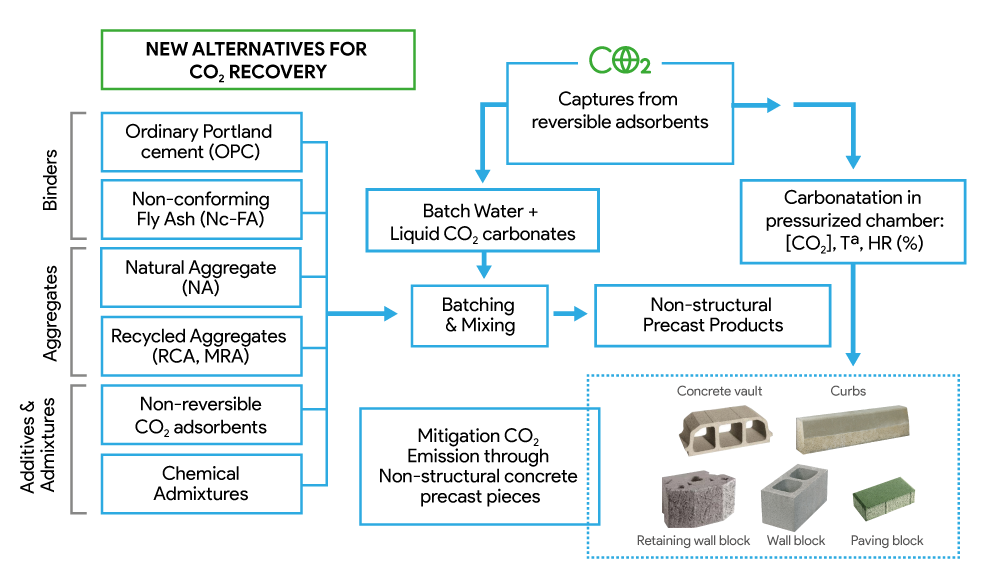
- CO₂ curing and carbonation of precast products to improve material properties and sustainability.
- Integration of recycled aggregates from construction and demolition waste (CDW), which have a higher carbonation capacity than natural aggregates.
- Substituting cement with non-conforming fly ash (Nc-FA) from thermoelectric power plants, reducing cement consumption.
- Utilization of carbonated water in concrete mixing, accelerating setting time and enhancing mechanical performance.
This project aligns with the 2017-2020 State Plan for Scientific and Technical Research and Innovation and the Horizon 2020 program, providing solutions for climate change mitigation and resource efficiency in construction.
INVESTIGADORES

Dr. Enrique Fernández Ledesma
Dr. David Suescum Morales
CALL, REFERENCE AND FUNDING
- Call: R&D&I Projects (2019)
- Reference: [Reference Number]
- Duration: [Start Date] – [End Date]
- Funding: [Details on funding]

OBJECTIVES
El proyecto PRECAST-CO₂ persigue la reducción de la huella de carbono en materiales a base de cemento mediante la aplicación de tecnologías de captura y utilización de CO₂.
- Síntesis y caracterización de nuevos adsorbentes de CO₂.
- Estudio de adsorción-desorción de CO₂ en distintas condiciones.
- Evaluación de la compatibilidad de adsorbentes irreversibles con el cemento.
- Fabricación de hormigón de referencia con áridos naturales.
- Incorporación de adsorbentes de CO₂ en mezclas de hormigón.
- Sustitución de áridos naturales por áridos reciclados de construcción y demolición.
- Reducción del cemento mediante el uso de cenizas volantes no conformes.
- Uso de agua carbonatada en el amasado del hormigón.
- Fabricación a escala industrial de prefabricados con menor huella de carbono.
- Transferencia al sector productivo, promoviendo recomendaciones industriales para la producción de elementos constructivos sostenibles.
ARTICLES
Our findings will be published in high-impact scientific journals, showcasing the development of CO₂ capture technologies for sustainable construction.
CONFERENCES
The PRECAST-CO₂ team actively participates in national and international conferences to present research progress and foster collaboration with experts worldwide.
THESES
This project has generated several PhD research opportunities, contributing to innovation in low-carbon materials.
DISSEMINATION
- Media publications on CO₂ capture in construction.
- Workshops and lectures for students and industry professionals.
- Participation in public engagement events to raise awareness about sustainable construction practices.
News
